
Enhancing Security in Houston’s Business Districts: Best Practices
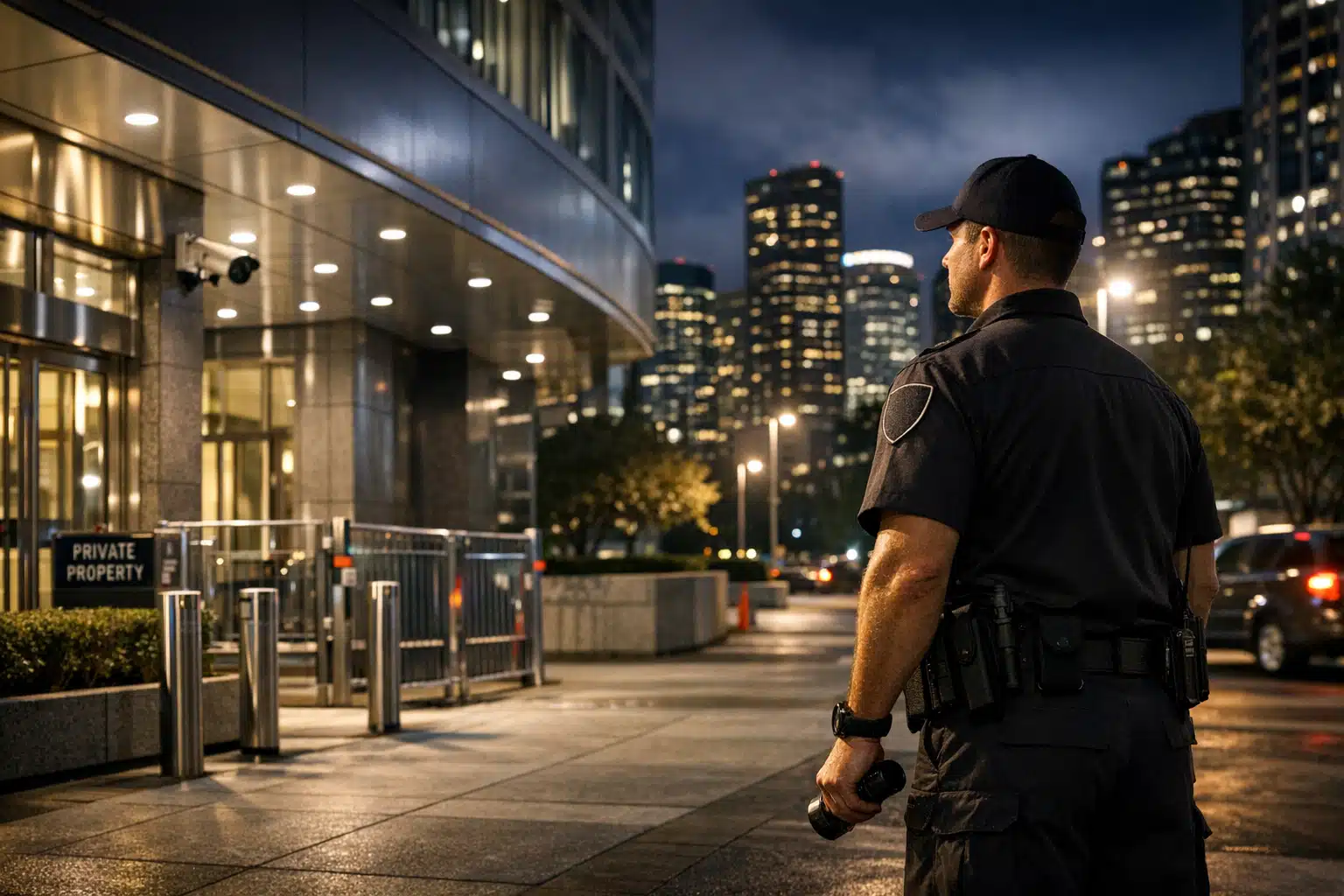
Why Houston Business Districts Face Distinct Security Pressures
Houston recorded over 100,000 property crime incidents in recent years, with commercial corridors among the hardest hit. Dense business districts concentrate foot traffic, vehicles, and high-value assets into tight spaces. That density creates opportunity for theft, vandalism, and trespassing.
Business district security in Houston must account for problems that suburban sites rarely face. Shared parking structures, mixed-use buildings, and 24-hour access points all widen the attack surface for criminals.
This post breaks down field-tested strategies for protecting downtown offices, the Energy Corridor, Uptown/Galleria, and Midtown properties. You will learn how layered protection reduces risk without draining your budget.
Mapping the Real Threats in Dense Houston Corridors
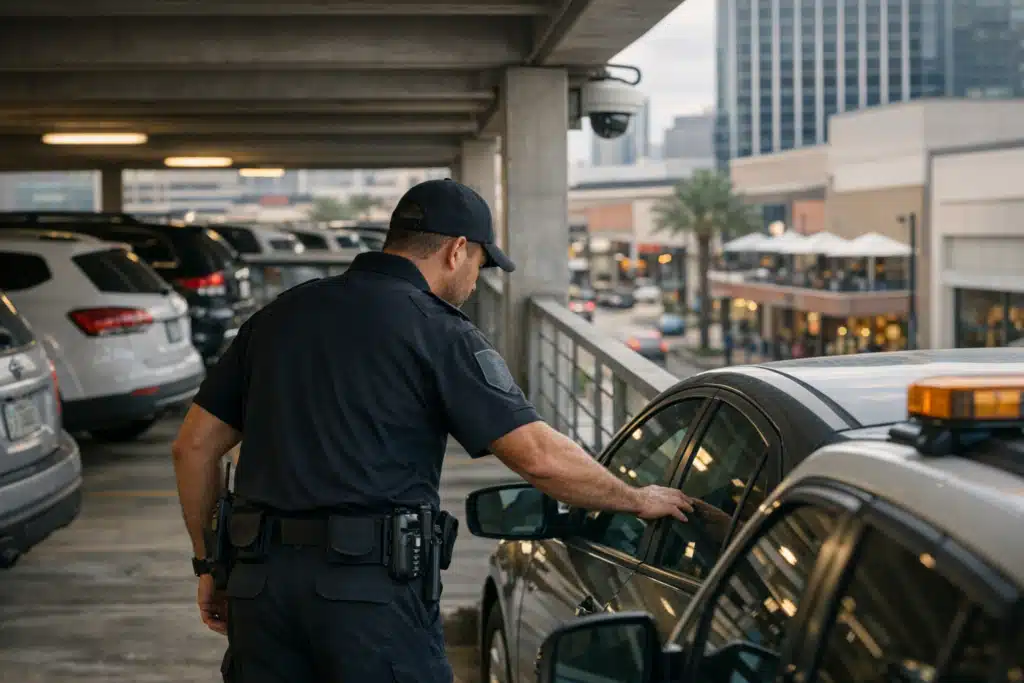
Different districts attract different threats. A downtown high-rise faces after-hours break-ins, garage prowlers, and loitering. A Galleria retail center deals with organized retail theft and vehicle burglaries.
Common threats by area
- Downtown & Midtown: Overnight break-ins, graffiti, and catalytic converter theft in parking garages.
- Energy Corridor: Perimeter breaches, badge misuse, and after-hours access to sensitive facilities.
- Uptown/Galleria: Retail theft rings, smash-and-grab attempts, and parking lot assaults.
- Washington Avenue: Late-night disturbances near bars restaurants, and vandalism.
Knowing your district’s pattern shapes every decision that follows. A generic plan wastes money on the wrong controls.
Building Layered Business District Security
Effective urban security solutions stack multiple defenses. If one layer fails, another catches the gap. This model works well in dense Houston corridors where entry points multiply fast.
The four layers that matter most
- Perimeter deterrence: Fencing, lighting, and clear signage that mark boundaries.
- Access control: Key cards, gate arms, and visitor logging at every entry.
- Detection: Cameras, motion sensors, and alarms that flag activity in real time.
- Human response: On-site guards or remote operators who act on alerts.
Each layer buys time and gathers evidence. A trespasser who clears a fence still faces cameras, alarms, and a live response.
Remote Video Surveillance for Multi-Tenant Buildings
Remote video monitoring covers wide areas at a fraction of the cost of full guard staffing. Trained operators watch live feeds from a central station. When they spot suspicious activity, they respond within seconds.
Where remote monitoring outperforms fixed cameras
Standard recorded cameras only help after a crime happens. Live-monitored systems stop incidents in progress. An operator can trigger a voice-down speaker and warn an intruder to leave.
This matters for Houston parking garages, where catalytic converter thefts spike overnight. A recorded video gives you a blurry plate. A monitored system gets a guard or police dispatched while the thief is still on site.
Cost advantage for business owners
Remote monitoring lets one operator watch several sites at once. For a multi-tenant Midtown building, that means overnight coverage without paying for a guard on every floor. Owners cut labor costs and keep response speed high.
Access Control in Mixed-Use and Shared Spaces
Shared entrances create the biggest weakness in Houston business districts. Tailgating, propped doors, and cloned badges let unauthorized people slip inside.
Practical fixes that work
- Anti-tailgating turnstiles at main lobbies during business hours.
- Time-based access that locks amenity floors and garages after hours.
- Audit logs reviewed weekly to catch badge sharing or odd entry times.
- Visitor management software that photographs and logs every guest.
Access data doubles as evidence. When an incident occurs, entry logs show who was inside and when.
On-Site Guards: Presence That Deters and Responds
Cameras record. Guards act. In dense districts, a visible uniformed guard cuts opportunistic crime fast.
What effective guard coverage looks like
A good guard program blends foot patrols with fixed posts. Foot patrols cover garages, stairwells, and loading docks where cameras have blind spots. Fixed posts control lobbies and main gates.
Guards trained for Houston conditions know the local threats. They recognize a prowler casing a garage versus a tenant walking to their car. That judgment prevents both crime and false alarms.
Texas licensing you should verify
Texas requires security personnel to hold licenses from the Texas Department of Public Safety Private Security Bureau. Before hiring any provider, confirm their guards carry valid commissions. Unlicensed guards expose your business to liability.

 Posted on Google
Protecting Energy Corridor and Port-Adjacent Properties
Energy facilities and port operations face regulated security demands. Companies near the Port of Houston must align with federal maritime rules under the Coast Guard.
Steps for energy and industrial sites
- Harden the perimeter with fencing, controlled gates, and vehicle inspection points.
- Log every contractor during turnarounds when hundreds of temporary workers arrive.
- Monitor the fence line with thermal cameras that see in darkness and rain.
- Coordinate with local law enforcement for rapid backup during breaches.
Turnaround periods raise risk sharply. A refinery might triple its headcount for weeks. That surge demands tighter access logging and extra patrol coverage.
Preparing Business District Security for Gulf Coast Hurricane Season
Hurricane season runs June through November on the Gulf Coast. Storms create a security gap when businesses evacuate and streets empty out. Looters target vacant commercial buildings after major storms.
A pre-storm security checklist
- Back up camera footage to cloud storage before the storm hits.
- Confirm battery and cellular backup for monitoring systems during power loss.
- Secure loose exterior items that wind could turn into projectiles.
- Arrange post-storm guard patrols for the first 72 hours after landfall.
Remote monitoring keeps working when your building sits empty. Cellular-backed systems watch your property even after grid power fails.
Coordinating Security Across a Whole District
Individual buildings protect themselves better when they share information. In corridors like the Galleria, neighboring properties face the same theft rings.
How district coordination helps
Property managers who share incident reports spot patterns early. A theft ring hitting one garage will target the next block soon. Shared alerts let neighboring guards watch for the same vehicles and faces.
A security partner that covers several sites in one district connects that intelligence naturally. One provider watching multiple properties sees the full picture.
Choosing the Right Security Partner in Houston
Ask hard questions before signing a contract. The right provider knows your district and answers clearly.
Questions to ask any provider
- Are your guards licensed by the Texas DPS Private Security Bureau?
- How fast do remote operators respond to a live alert?
- Do you carry liability insurance, and what are the limits?
- Can you cover both guard patrols and remote video from one contract?
- What is your plan for hurricane season and power outages?
A provider who dodges these questions is a risk. Clear answers signal real local expertise.
Conclusion
Business district security in Houston works best when layered defenses combine perimeter control, remote video, access management, and trained guards. Match your plan to your district’s specific threats and prepare for Gulf Coast storm season. Coordinated coverage across nearby properties multiplies protection for everyone.
Twin City Security Houston builds protection plans for downtown towers, Energy Corridor facilities, port operations, and retail centers across the metro. Call 832‑301‑9478, email Houston@Twincitysecurity.com, or visit https://www.twincitysecurityhouston.com for a Houston security assessment or monitoring quote.
Sources
Recent Posts