
How Remote Surveillance Enhances Security for Houston’s Energy Sector Facilities
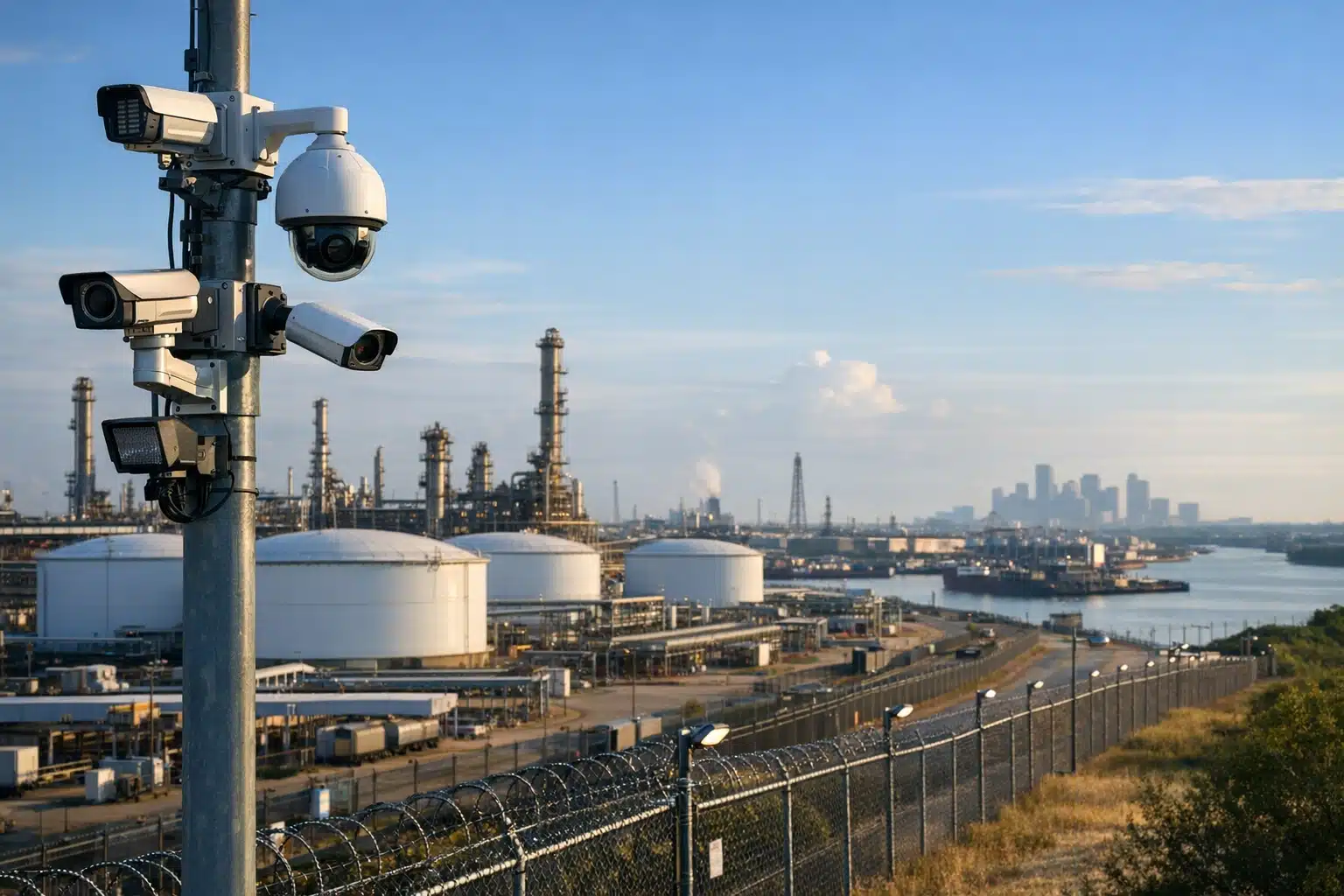
The Houston Ship Channel moves roughly $906 billion in economic value each year, and hundreds of energy facilities line its banks. That concentration of pipelines, tank farms, and refineries makes energy sector surveillance a serious concern for operators across Harris County. Copper theft, unauthorized drone flights, and after-hours trespass all threaten sites from Baytown to the Energy Corridor. This post explains how remote video surveillance protects Houston energy facilities, what implementation looks like on the ground, and how it holds up during Gulf Coast storm season.
Why Houston Energy Facilities Face Distinct Security Risks
Houston sits at the center of the U.S. petrochemical map. The Port of Houston ranks first in the nation for foreign waterborne tonnage. That scale attracts both opportunistic and organized threats.
Energy sites here share a common weakness: sprawling perimeters. A single tank farm can span dozens of acres with miles of fence line. Guards on foot cannot watch every section at once.
Common Threats to Houston Energy Sites
- Metal and copper theft from grounding systems, wiring, and idle equipment
- Perimeter breaches at fence lines and remote access gates
- Fuel and product theft during off-hours loading windows
- Trespass and sabotage risk near pipelines and control infrastructure
- Unauthorized drone activity over restricted operational zones
Copper theft alone costs U.S. businesses close to $1 billion annually. Idle refinery units during turnarounds become prime targets when foot traffic drops.
How Remote Surveillance Strengthens Energy Sector Security
Remote surveillance uses networked cameras, analytics, and live operators watching from an off-site center. It closes the gaps that fixed guard posts leave open across large energy properties.

Instead of one guard covering one gate, cameras cover the full perimeter at once. Trained operators verify alerts and respond in real time.
Video Analytics That Catch Threats Early
Modern camera systems flag activity based on behavior, not just motion. This cuts false alarms from wildlife, weather, and passing traffic near the Ship Channel.
Analytics used at Houston energy sites include:
- Line-crossing detection along fence perimeters and pipeline corridors
- Loitering alerts near tanks, pumps, and control buildings
- Object-left-behind detection in secure zones
- License plate recognition at truck and rail entry points
- Thermal imaging for total darkness and dense fog off Galveston Bay
Live Voice-Down Deterrence
When an operator spots an intruder, they speak directly over on-site speakers. A live voice telling a trespasser they are being watched stops most intrusions cold.
This matters at 3 a.m. on a Katy Prairie substation or a La Porte tank farm. Deterrence beats after-the-fact footage every time.
Remote Monitoring During Gulf Coast Hurricane Season
Hurricane season runs June through November along the Texas coast. Houston energy operators face a hard choice during evacuations: leave sites unguarded or risk staff safety.
Remote monitoring keeps eyes on facilities after personnel evacuate. Operators watch storm damage, flooding, and looting attempts from a hardened off-site center.
What Surveillance Provides Before and After a Storm
- Pre-storm checks confirm gates, doors, and equipment are secured
- During the storm, operators track flooding and structural damage remotely
- Post-storm, cameras document damage for insurance and OSHA records
- Recovery phase, monitoring blocks looters targeting abandoned equipment
After Hurricane Harvey, many Ship Channel facilities sat empty for days. Sites with remote monitoring caught intrusion attempts that unmanned properties never saw.
Meeting Texas and Federal Compliance Requirements
Energy facilities near the Port of Houston fall under Maritime Transportation Security Act rules. The U.S. Coast Guard enforces these standards for waterfront operations.
Surveillance supports compliance in measurable ways:
- MTSA facilities must control access and monitor restricted areas
- Recorded footage supports incident reporting and audits
- CFATS-covered sites need documented perimeter security
- Texas DPS licensing governs the guards and monitoring firms you hire
Always confirm your provider holds a valid Texas private security license. Twin City Security Houston operates under Texas Department of Public Safety regulation.
Combining Remote Surveillance With On-Site Guards
Cameras and operators handle detection. On-site officers handle physical response. The strongest energy site security pairs both.
A remote operator spots a fence breach at a Pasadena tank farm. That operator dispatches an on-site guard and calls Houston police at the same time. Response time drops from minutes to seconds.
When Each Approach Fits Best
- Remote-only monitoring suits smaller substations and idle equipment yards
- Guards plus cameras fit active refineries and high-traffic port terminals
- Hybrid coverage works for facilities that scale staff during turnarounds
Turnaround periods bring hundreds of temporary contractors on-site. Access control and camera coverage keep that crowd accountable.

 Posted on Google
Steps to Implement Energy Sector Surveillance in Houston
Setting up remote surveillance follows a clear order. Skipping steps leaves blind spots that intruders find fast.
- Assess the site. Walk the perimeter, map access points, and note dark zones.
- Prioritize high-value assets. Focus first on tanks, control rooms, and metal-heavy areas.
- Choose camera types. Match thermal, PTZ, and fixed cameras to each zone.
- Set analytics rules. Define virtual boundaries and alert conditions.
- Connect to a monitoring center. Route alerts to trained live operators.
- Test storm resilience. Confirm backup power and cellular failover work.
- Review and adjust. Refine alert zones after the first 30 days.
Questions to Ask Before Hiring a Provider
- Are your operators based in a monitored, staffed center?
- How do you handle false alarms near the Ship Channel?
- What is your storm-season continuity plan?
- Do you hold current Texas DPS security licensing?
- Can you coordinate directly with Houston-area law enforcement?
The Cost Case for Remote Monitoring
One remote operator can watch multiple camera feeds across several sites. That coverage costs less than staffing every gate with round-the-clock guards.
Compare the math for a mid-size tank farm:
- Full guard coverage at multiple posts runs into six figures yearly
- Remote monitoring covers the same perimeter at a fraction of that
- Hybrid models place guards only where physical presence pays off
Add prevented theft and lower insurance exposure, and the return grows. Documented surveillance often lowers premiums on high-value energy assets.
Protecting Houston’s Energy Corridor and Beyond
The Energy Corridor along I-10 West holds major operator headquarters and data centers. These sites need surveillance built for people, parking structures, and intellectual property.
Coverage across the metro varies by site type:
- Energy Corridor offices — access control and parking garage monitoring
- Port of Houston terminals — MTSA-compliant perimeter and gate coverage
- Baytown and Pasadena refineries — thermal perimeter and turnaround monitoring
- Clear Lake and Bay Area sites — flood-aware storm-season watch
Each area faces different risks. A single template fails across such varied sites.
Conclusion
Remote surveillance gives Houston energy operators full-perimeter coverage, faster response, and storm-season protection that fixed guards alone cannot match. Pairing live monitoring with on-site officers cuts theft, meets Texas and federal rules, and lowers long-term cost. Twin City Security Houston builds energy sector surveillance plans around your specific site, from Port terminals to Energy Corridor offices.
Call 832‑301‑9478, email Houston@Twincitysecurity.com, or visit https://www.twincitysecurityhouston.com for a Houston security assessment or monitoring quote.
Sources
Recent Posts