
Implementing Advanced Surveillance in Houston’s Office Complexes
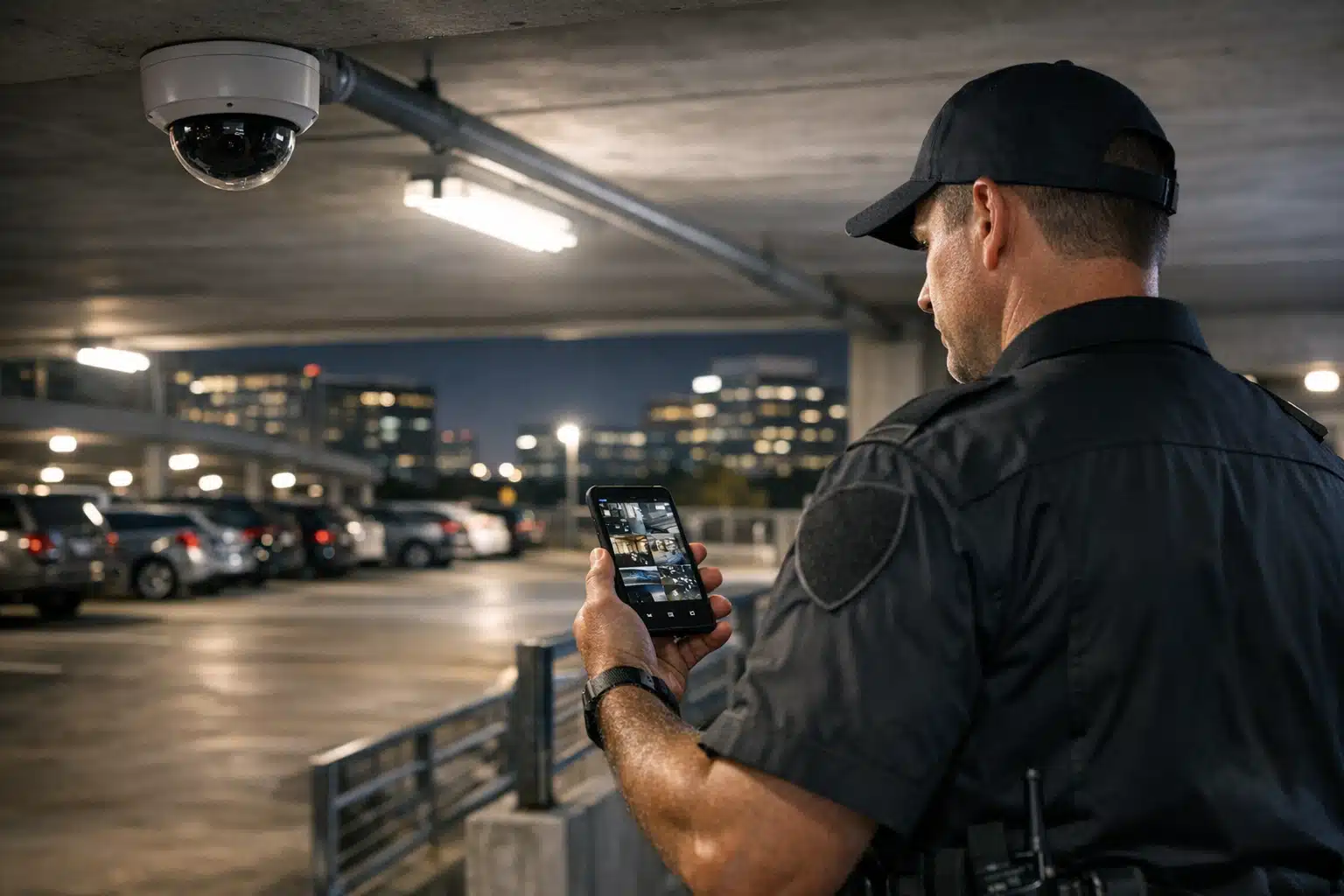
Houston recorded more than 100,000 property crime incidents in recent years, and office complexes remain frequent targets after hours. Office complex surveillance has shifted from passive camera recording to active monitoring that stops incidents before damage occurs. This post breaks down what modern systems do, how they apply to Houston properties, and what facility managers should ask before signing a contract.
Office buildings in areas like the Energy Corridor, Greenway Plaza, and Westchase face specific risks. Parking garage break-ins, vandalism, tailgating at entrances, and after-hours trespassing happen regardless of lobby staffing.
The difference between a system that records a crime and one that prevents it comes down to integration. Cameras alone do not stop theft. Monitored cameras paired with trained operators do.
Why Office Complex Surveillance Matters for Houston Properties
Houston’s commercial districts spread across a wide footprint with low-density parking and multiple access points. A single office campus can have dozens of blind spots.
Traditional guard patrols cover one location at a time. A guard checking the north garage cannot see the loading dock on the south side.
Advanced office complex surveillance fills that gap. Camera networks with analytics watch every zone at once and flag unusual activity in real time.
Common Threats to Houston Office Complexes
- Vehicle break-ins in multi-level parking garages, concentrated in evening hours
- Copper and catalytic converter theft targeting parked fleet vehicles and HVAC units
- Tailgating at badge-controlled entrances during shift changes
- After-hours trespassing on vacant floors during tenant turnover
- Vandalism and graffiti on exterior walls and signage
Each threat has a predictable pattern. Systems built around those patterns catch problems earlier.
How Advanced Surveillance Systems Protect Modern Office Buildings
Advanced surveillance uses video analytics to separate real threats from routine movement. The software learns normal activity and alerts on exceptions.
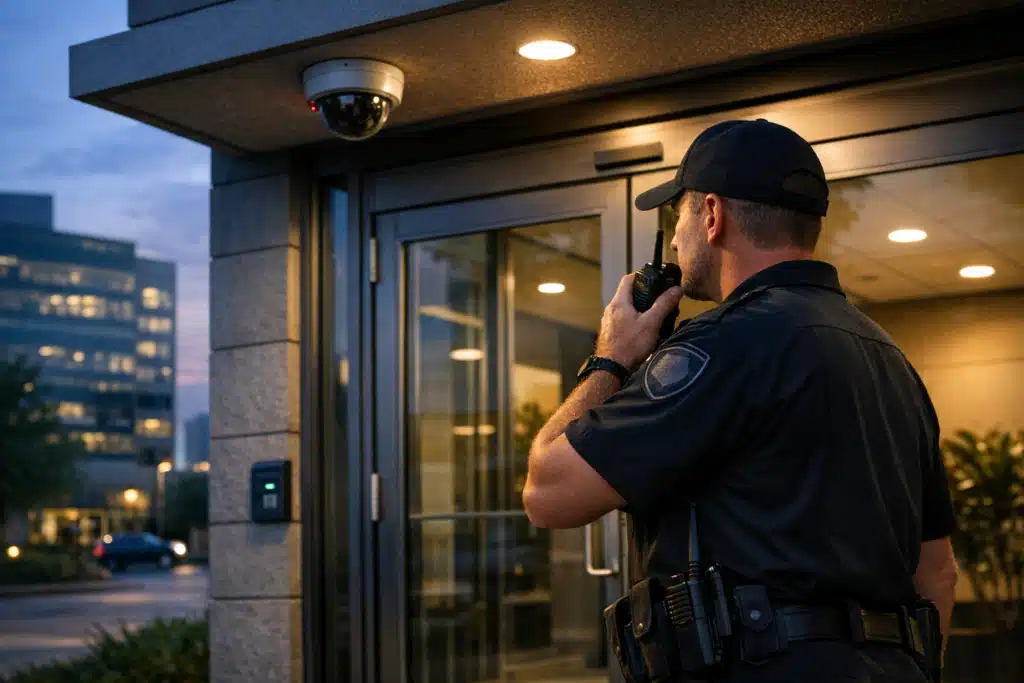
A person walking to a parked car at 6 PM looks different from a person moving between vehicles at 2 AM. Analytics flag the second behavior automatically.
What Video Analytics Can Detect
- Loitering near entrances, garages, or ATMs beyond a set time limit
- Perimeter crossing into restricted zones after business hours
- Vehicle lingering in fire lanes or loading areas
- Crowd formation that may signal a disturbance
- Abandoned objects left in lobbies or walkways
When the system detects one of these events, it sends live video to a monitoring operator. That operator verifies the threat and responds within seconds.
Live Remote Monitoring Versus Recorded-Only Systems
Recorded footage helps after a crime. It rarely prevents one. Live remote monitoring changes the equation.
A trained operator watching flagged events can trigger a voice-down warning over on-site speakers. The intruder hears a direct message and most leave immediately.
If the person stays, the operator dispatches police or on-site guards with a verified report. Verified alarms get faster law enforcement response than standard alarm calls.
Houston Security Technology Built for Local Conditions
Gulf Coast weather tests every outdoor system. Houston heat, humidity, and hurricane-force winds destroy equipment that was not built for the climate.
Effective Houston security technology uses weather-rated camera housings, surge protection, and backup power. During a storm, cameras that lose power leave your property blind.
Preparing Office Complex Surveillance for Hurricane Season
Hurricane season runs June through November. Office complexes sit empty during evacuations, which makes them targets for looting and theft.
Follow these steps to keep surveillance active during severe weather:
- Install battery or generator backup for cameras and recorders
- Use cellular failover so footage transmits when internet lines go down
- Mount cameras on reinforced housings rated for high wind
- Store footage off-site in the cloud, not only on local drives
- Schedule remote monitoring coverage during and after evacuation orders
A property with cloud storage and cellular backup keeps watch even when the building is dark and abandoned.
Integrating Surveillance With Access Control and On-Site Guards
Cameras work best as part of a layered system. Access control, video analytics, and human response reinforce each other.
When a badge reader denies entry, the system can pull up the nearest camera. An operator sees who tried to enter and decides whether to act.
A Layered Setup for a Houston Office Campus
- Perimeter cameras with analytics covering parking and entry roads
- Badge access at lobby doors, stairwells, and elevators
- Interior cameras in common areas and vacant floors
- Live monitoring that verifies alerts and triggers voice-downs
- Mobile guard response for events requiring physical presence
This structure means fewer guards cover more ground. Technology handles detection, and people handle response.
Cost Factors for Office Complex Surveillance
Pricing depends on property size, camera count, and monitoring hours. A mid-size office campus in Westchase needs different coverage than a single building in The Woodlands.
Main cost drivers include:
- Number of cameras and whether they include analytics
- Monitoring schedule such as after-hours only or 24/7
- Storage duration for recorded footage
- On-site guard hours paired with remote monitoring
Many Houston properties reduce costs by shifting from full guard staffing to monitored cameras with on-call response. The savings fund better camera coverage.

 Posted on Google
Texas Regulations and Liability Considerations
Security companies in Texas must hold licenses from the Texas Department of Public Safety. The Private Security Bureau regulates guards, alarm monitoring, and investigators.
Hiring a licensed provider protects you from liability. Unlicensed operators expose your property to legal risk if an incident goes wrong.
Ask any provider for their DPS license number before signing. A legitimate Houston firm shares it without hesitation.
What to Ask Before Hiring a Houston Surveillance Provider
Facility managers should vet providers with direct questions. The answers reveal whether a company understands local conditions.
- Are your monitoring operators based locally or out of state?
- How fast do operators respond to a flagged event?
- What happens to my system during a hurricane or power outage?
- Do you integrate with my existing access control?
- Can you provide references from other Houston office properties?
A provider who answers these clearly knows the work. Vague responses signal a vendor selling boxes, not protection.
Conclusion
Modern office complex surveillance combines video analytics, live monitoring, and on-site response to stop incidents before they escalate. Houston properties face heat, storms, and predictable crime patterns that demand systems built for local conditions. The right setup covers every zone, holds up through hurricane season, and reduces reliance on round-the-clock guard staffing.
Twin City Security Houston designs surveillance systems for office complexes across the Energy Corridor, Westchase, Greenway Plaza, and beyond. Call 832‑301‑9478 or email Houston@Twincitysecurity.com for a property assessment and monitoring quote.
Sources
Recent Posts