
Best Practices for Transitioning Between Security Providers in Houston

Why Switching Security Vendors Puts Houston Sites at Risk
Houston reported over 100,000 property crimes in recent years, according to city police data. A single unguarded hour can invite theft, vandalism, or trespassing.
That risk grows during a vendor change. Transitioning security providers creates gaps when the old team leaves before the new one learns your site.
This post walks Houston business owners, property managers, and energy operators through a safe switch. The goal is zero coverage loss and no drop in protection during the handoff.
The Real Cost of a Botched Security Provider Transition
A poorly planned switch does more than annoy your staff. It exposes physical assets during the most vulnerable window.
Consider a Katy retail center that let its contract lapse on a Friday. The new team started Monday. Thieves hit the loading dock over the weekend.
Common failure points during a transition
- Coverage gaps between the last shift of the old guard and the first shift of the new one.
- Lost site knowledge, such as gate codes, patrol routes, and known trespasser patterns.
- Access control confusion when key fobs, badges, or camera logins are not handed over.
- Post order gaps, where written instructions from the old vendor never reach the new one.
Each gap costs money. For energy sites near the Ship Channel, a lapse can trigger compliance violations too.
Plan Your Houston Security Provider Transition in Advance
Start planning 60 to 90 days before your current contract ends. This timeline gives both vendors room to coordinate.
Rushing the switch is the top reason sites lose coverage. A short runway forces you to accept whoever is available, not who fits your site.
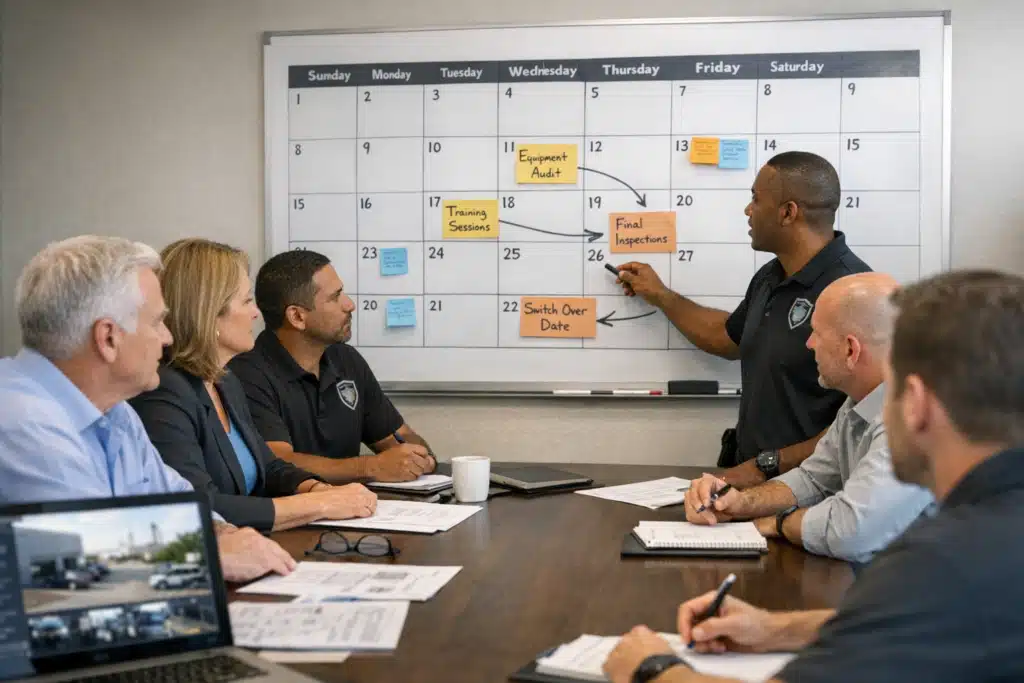
Step-by-step transition timeline
- Days 90-60: Review your current contract for notice requirements and cancellation penalties.
- Days 60-45: Interview new Houston security services and request site-specific proposals.
- Days 45-30: Select your new vendor and schedule an overlap period.
- Days 30-14: Hand over post orders, access credentials, and site maps.
- Days 14-0: Run overlapping shifts so new guards shadow the outgoing team.
The overlap period matters most. A day or two of paired shifts prevents nearly every knowledge gap.
Read Your Current Contract Before Transitioning Security Providers
Your existing agreement controls the exit terms. Many Houston contracts require 30 or 60 days written notice.
Miss the notice window and you may pay for months you no longer want. Some contracts auto-renew if you stay silent past a set date.
What to check in your contract
- Notice period and the exact method required, such as certified mail.
- Auto-renewal clauses that lock you in for another term.
- Early termination fees tied to remaining contract months.
- Equipment ownership, since some vendors own the cameras on your property.
That last point trips up many facility managers. If your old vendor owns the surveillance hardware, you need a plan to replace it fast.
Protect Access Credentials During the Handoff
Access control is where transitions leak the most risk. The outgoing team knows your codes, badges, and camera passwords.
Change every credential the day the old contract ends. This step matters for apartment communities in the Energy Corridor and gated construction sites in Clear Lake.
Credential handover checklist
- Reset gate codes and keypad PINs after the final shift.
- Deactivate old key fobs and badges issued to former guards.
- Update camera and DVR login passwords for remote monitoring.
- Recover all physical keys and document the count.
Skipping these steps leaves former staff with live access. That is a liability no property manager wants.
Transfer Site Knowledge to the New Team
Guards protect what they know. A new officer who has never walked your Port of Houston terminal will miss blind spots.
Written post orders carry site knowledge from one vendor to the next. Insist on receiving them from your outgoing provider.
Site knowledge to document
- Patrol routes and timing for each shift.
- High-risk zones like loading docks, fuel storage, and dark corners.
- Known trespasser patterns and past incident logs.
- Emergency contacts for police, fire, and site management.
- Local police non-emergency numbers for the correct HPD division.
A construction firm in The Woodlands cut false alarms by half after passing detailed logs to its new team. Knowledge transfer paid off within weeks.

 Posted on Google
Keep Remote Video Monitoring Running During the Switch
Remote video surveillance should never go dark during a transition. Cameras watch your site even when guards rotate out.
If your old vendor owned the monitoring platform, coordinate the cutover to the minute. Test the new feed before the old one shuts off.
Steps to maintain monitoring continuity
- Confirm camera ownership and whether you keep the hardware.
- Install and test new monitoring feeds before ending the old service.
- Run both systems in parallel for at least 24 hours.
- Verify recording storage transfers or restarts cleanly.
Parallel operation costs a little extra. It buys certainty that no camera goes blind mid-switch.
Time Your Transition Around Gulf Coast Weather
Never switch security providers during hurricane season peak without a storm plan. Houston sits in a high-risk zone from June to November.
A vendor change days before a named storm invites chaos. New guards may not know your evacuation routes or shutdown steps.
Weather-aware transition tips
- Avoid final cutover dates in late August and September if you can.
- Brief the new team on storm protocols before the switch completes.
- Confirm generator and backup power coverage for monitoring gear.
- Document evacuation monitoring plans for staffed and remote sites.
Refinery operators along the Ship Channel face added pressure. Turnaround schedules and storm prep leave little room for coverage gaps.
Verify Licensing and Insurance Before You Sign
Texas requires security firms to hold a license from the Department of Public Safety. Verify this before hiring any new vendor.
An unlicensed guard company exposes you to legal and insurance problems. Ask for the license number and confirm it directly.
Vet your new provider on these points
- Active Texas DPS license for the security company.
- Guard-level licensing, since Texas requires individual officer registration.
- General liability insurance with proof of coverage.
- Local Houston presence for fast response and site familiarity.
A local team beats a distant call center during an incident. Houston knowledge shortens response time when minutes count.
Run a 30-Day Post-Transition Review
The switch is not finished when the new team arrives. Track performance for the first month to catch problems early.
Review incident reports, patrol logs, and response times weekly. Adjust post orders where the new team spots gaps you missed.
What to measure after the switch
- Shift coverage with no missed or late arrivals.
- Incident response times compared to your old vendor.
- Report accuracy and detail in daily activity logs.
- Camera uptime for remote monitoring feeds.
Honest tracking tells you fast whether the new vendor delivers. A good provider welcomes the scrutiny.
Conclusion
A smooth security transition comes down to planning, credential control, and knowledge transfer. Overlap your vendors, verify licensing, and time the switch away from storm season. These steps close the coverage gaps that cost Houston sites the most.
Twin City Security Houston helps businesses switch guard and remote monitoring coverage without protection gaps. Call 832‑301‑9478, email Houston@Twincitysecurity.com, or visit https://www.twincitysecurityhouston.com for a site assessment.
Sources
Recent Posts